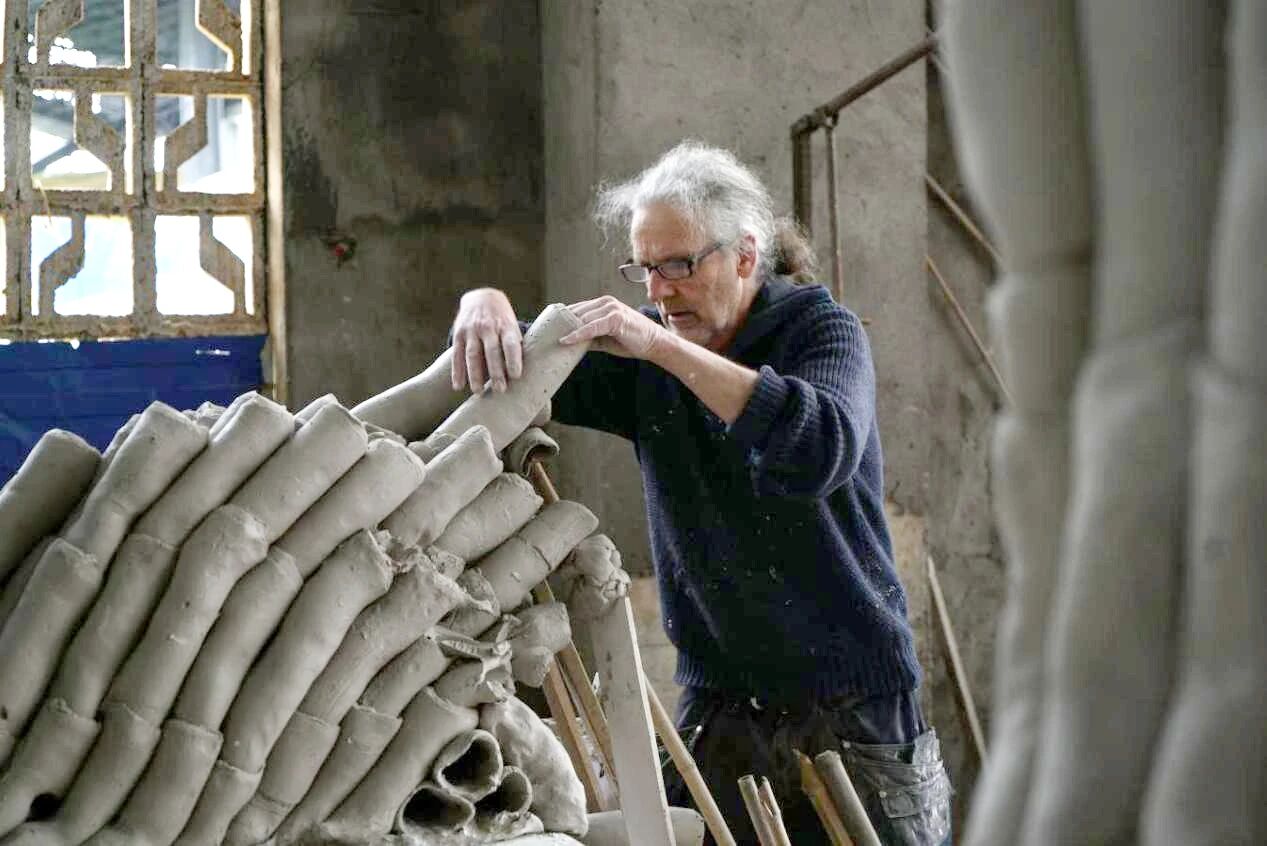
托比恩·卡瓦斯博(Torbjørn Kvasbø)
国际陶艺学会(IAC)荣誉主席
20世纪70年代挪威当代陶瓷艺术运动主要参与者
Q:于伶娜
A:托比恩·卡瓦斯博
Q:景德镇国际陶艺双年展已成功举办两届,作为总策展人之一,谈谈你的观察和评价。
A:景德镇国际陶瓷双年展在很短时间内就成为最重要的双年展之一,尤其对年轻陶艺家意义重大。它是国际陶艺走进中国、中国陶艺走向世界的重要窗口。因参与者众多,规模宏大且令人印象深刻——无论是参展作品数量,还是展览呈现方式,都体现出专业的国际水准,这是它已建立的声誉。
对年轻且有潜力的陶艺家(尤其是中国年轻陶艺家)来说,双年展非常重要。现在很多年轻人学习陶艺,希望成为专业艺术家,他们申请参展是因为永远不知道评委如何看待自己的作品,评委或许会认为其作品是当下年轻人的有趣表达,所以我总会鼓励大家申请国际展览。
此外,申请者平均年龄在下降,很多学生参与,这让我们这些深耕领域多年的人很欣慰。但行业存在人才流失问题,多数申请者也关注环境与可持续发展,年轻艺术家会在作品或申请材料中反映对生产、未来的思考,他们从事陶艺的背景故事也很有意思。
Q:2026年“瓷的未来”景德镇国际陶艺双年展将与国际陶艺学会第52届年会同期举办,这对参展艺术家意味着什么?
A:2026年景德镇国际陶艺双年展将于6月29日开幕,这一时间安排得益于吕品昌先生——他不仅促成了国际陶艺年会与双年展的联动,也是景德镇陶艺双年展的核心策划者,为推动中外陶艺界的国际交流做出了巨大贡献。
两大事件的联动,从积极层面来说,这给了艺术家参与更多行业活动的机会,但同时也是个大难题。国际范围内的陶艺家数量本就有限,不少艺术家因作品体量过大,存在运输成本高、物流难度大等问题,最终无法参展。我认为相关主办方应当加强协作,共同协调出一个错峰的日程表,让更多艺术家能有机会参与到这两项活动中。
另外,能入围双年展本身就是重要的职业加持——艺术家可以将参展经历写入简历;若能斩获奖项,不仅能提升国际知名度,还能为个人艺术生涯积累重要的行业资本,奖金更是能为创作提供切实助力。
Q:你创作时,指纹会留在黏土上,而青年艺术家参与双年展,会留下什么,又能从中收获什么?
A:黏土能“接收”所有操作,柔软的黏土特性奇妙,烧制后能永久保存创作痕迹,成为记录那一刻的历史档案,也是反映当代历史的重要文献。一旦创作完成,便是很好的记录。
所以青年艺术家参与双年展,留下的是作品中承载的创作痕迹与时代思考;收获的则是展示机会、行业认可与对自身创作的启发。(建议多参加展览,这是我最好的建议。)
先说说收获,参展能让青年艺术家的作品和名字在全球范围内传播,社交媒体的传播效应更是能为他们的履历增添重要筹码。
至于能留下什么,其实青年艺术家的创作本身就是时代的注脚。现在参展申请者的平均年龄在下降,很多学生也会踊跃报名,他们的作品往往会折射出对环境、可持续发展等议题的关注,还会在申请材料中阐述创作的底层逻辑,这些都能为双年展注入鲜活的时代思考。
我也一直建议所有青年创作者都积极申报各类国际陶艺展,毕竟评委的审美取向多元,说不定你的作品就能触动评委,成为展现当代青年陶艺表达的典型案例。
Q:作为国际陶艺学会(IAC)的荣誉主席,你见证了全球多个顶级陶瓷双年展的演进。与拥有数十年历史的意大利法恩扎双年展、日本美浓国际陶艺展、韩国京畿道国际陶瓷双年展相比,年轻的景德镇双年展在你看来,其核心竞争力在哪里?
A:景德镇陶艺双年展创办时间不长,算上2026年的展会也才举办三届,但它已经在短时间内成长为国际上极具影响力的陶艺双年展,尤其对青年陶艺家而言是重要的展示平台。它不仅是国际陶艺界了解中国的窗口,也是中国陶艺走向世界的桥梁——其参展规模、作品数量和展陈专业度都极具优势,已然树立起专业的国际双年展口碑。
作为新兴双年展,它的一大竞争力在于能借鉴其他成熟展会的经验,在短时间内搭建起完善的运营体系,能高质量地处理作品征集、评审、展陈等全流程工作,这对一个年轻的国际展会来说是很难得的。
Q:你曾提出“传统是正在发生且不断变化的”,那么将传统做到极致和打破传统,哪种路径更契合陶艺的未来?
A:对认真的陶艺家而言,大家会持续深耕材料、坚持实验探索、保持创作热忱和好奇心,不会刻意纠结“创新”“破传统”“立传统”这类标签。这些创作层面的突破和传承,会随着艺术家专注的创作状态自然发生。其实核心不在于形式上是延续还是打破传统,而在于创作者能否坚持自我——“做真实的自己”本身就是极具独特性的表达。
我们评审更看重作品中传递的“自己”本身的独一无二,比如创作者对所处时代、生活境遇、传统价值、国际局势的深层思考,简言之,我寻找的是独特、深刻的个人表达,仅此而已。
此外,创作内容与背后的历史积淀很重要,若不真诚面对自己,创作便会走入死胡同。
Q:你如何看待AI陶艺创作?是否认可这类作品的艺术价值?
A:我评判一件陶艺作品的核心标准,是它能否和观者建立深度联结——当观者看到作品时,能否由此展开对自身生活的反思,而这种联结的建立,源于艺术家将自身的情感与思考注入了作品。AI陶艺创作若能实现这种深层的情感与思想传递,那它就具备了相应的艺术价值;反之,若只是技术层面的堆砌,就很难称得上有真正的艺术意义。
Q:你曾提出“陶瓷艺术应成为时代精神的当代代表”,你认为当前全球陶瓷艺术行业面临的最大挑战是什么?2026年景德镇陶艺双年展将如何回应这一挑战?
A:首先要区分陶瓷产业和陶瓷艺术:陶瓷产业正面临污染严重、成本高企、市场需求萎缩等严峻问题;而陶瓷艺术本身具备循环经济的属性,但全球环境危机也已深刻影响了陶瓷艺术领域,这也是当下行业的核心挑战。现在很多青年陶艺家都高度关注可持续议题,他们会在创作中践行环保理念,比如采用低温烧制工艺、使用无毒材料等,其作品也会成为对时代议题的有力回应。2026年的双年展也会持续关注这类创作,陶瓷艺术本就该成为时代的发声器,这也是我们希望在展会上看到更多的核心方向。
Q:你希望在明年双年展上看到哪些新面孔或新思想?对景德镇陶艺双年展及陶瓷艺术的未来有哪些期待?
A:我希望看到更多从未申请过的年轻人,也希望曾参与两届的艺术家能有新突破,持续探索并提交作品。但作为评委,我个人更关注能带来新知识、新信息的作品,简而言之,我期待“创新”。
对于双年展的未来,我期望它能打破同质化困局——现在很多国际双年展的征稿方向和参展群体都趋于雷同,缺乏新意。我认为未来的双年展必须更多地做出改变,每两年尝试一些变化,比如采用邀请制,强化对展陈内容的把控,每届都打造差异化的主题和内容。至于陶瓷艺术的未来,我希望创作者能主动发声,通过作品传递对世界的思考,尽可能提升个人作品的国际曝光度,建立属于自己的创作话语权,毕竟如果自己不掌控创作和人生的方向,就会被外界裹挟。
Q:最后,请向全球艺术家发出邀请,鼓励他们积极参与景德镇双年展。
A:希望全球艺术家积极参与,你的作品和名字会因此传遍世界。社交媒体的传播效果极佳,这也是吸引大家报名的一大优势,因为参与景德镇国际陶艺双年展,就像参与世界上其它知名双年展一样,能获得广泛关注。
英文版
Exclusive Interview with Torbjørn Kvasbø, Honorary President of IAC: Jingdezhen Biennale, a Crucial Milestone for Young Artists to Leap Over
Torbjørn Kvasbø
Honorary President of the International Academy of Ceramics (IAC)
Key participant in Norway's contemporary ceramic art movement in the 1970s
Q: Yu Lingna
A: Torbjørn Kvasbø
Q: The Jingdezhen International Ceramic Biennale has been successfully held twice. As one of the chief curators, what are your observations and evaluations?
A: The Jingdezhen International Ceramic Biennale has become one of the most important biennales in a short period of time, especially significant for young ceramic artists. It serves as a vital window for international ceramics to enter China and for Chinese ceramics to step onto the world stage. Impressive in scale due to the large number of participants, it reflects professional international standards both in the quantity of exhibited works and the exhibition presentation—this is the reputation it has established.
For young and promising ceramic artists, especially Chinese ones, the biennale is extremely important. Many young people now study ceramics and aspire to become professional artists. They apply to participate because they never know how judges will perceive their works—judges may see their creations as interesting expressions of contemporary youth. That’s why I always encourage everyone to apply for international exhibitions.
Additionally, the average age of applicants is decreasing, with many students participating, which brings great joy to those of us who have worked in the field for years. However, the industry faces a brain drain issue. Most applicants also pay attention to environmental and sustainable development issues. Young artists reflect their thoughts on production and the future in their works or application materials, and their background stories in engaging with ceramics are also very interesting.
Q: The 2026 "Future of Ceramics" Jingdezhen International Ceramic Biennale will be held concurrently with the 52nd Conference of the International Academy of Ceramics (IAC). What does this mean for participating artists?
A: The 2026 Jingdezhen International Ceramic Biennale will open at June 29th.This scheduling is thanks to Mr. Lv Pinchang—he not only facilitated the link between the IAC Annual Conference and the biennale but is also the core planner of the Jingdezhen Ceramic Biennale, making tremendous contributions to promoting international exchanges between Chinese and foreign ceramic circles.
On the positive side, the linkage of these two major events provides artists with more opportunities to participate in industry activities, but it also poses a significant challenge. The number of ceramic artists worldwide is inherently limited, and many artists cannot participate due to issues such as high transportation costs and logistical difficulties caused by the large size of their works. I believe the relevant organizers should strengthen collaboration and jointly coordinate a staggered schedule to allow more artists to participate in both events.
Furthermore, being shortlisted for the biennale itself is an important career boost—artists can include the exhibition experience in their resumes. Winning an award not only enhances international visibility but also accumulates important industry capital for one’s artistic career, and the prize money provides practical support for creative work.
Q: When you create, your fingerprints remain on the clay. What will young artists leave behind when participating in the biennale, and what can they gain from it?
A: Clay "absorbs" all operations. The wonderful property of soft clay allows creation traces to be permanently preserved after firing, becoming a historical record of that moment and an important document reflecting contemporary history. Once the creation is completed, it serves as an excellent record.
Therefore, when young artists participate in the biennale, they leave behind the creation traces and contemporary reflections embodied in their works; what they gain is exhibition opportunities, industry recognition, and inspiration for their own creation. (My best advice is to participate in more exhibitions.)
Speaking of gains, participating in the exhibition allows young artists' works and names to be promoted globally, and the communication effect of social media adds important weight to their resumes.
As for what they leave behind, the creations of young artists themselves are footnotes to the times. Currently, the average age of applicants is decreasing, and many students actively sign up. Their works often reflect concerns about issues such as the environment and sustainable development, and they also elaborate on the underlying logic of their creation in the application materials. All these inject vivid contemporary reflections into the biennale.
I have always advised all young creators to actively apply for various international ceramic exhibitions. After all, judges have diverse aesthetic orientations—perhaps your work will resonate with the judges and become a typical case demonstrating the expression of contemporary young ceramic artists.
Q: As the Honorary President of the International Academy of Ceramics (IAC), you have witnessed the evolution of many top international ceramic biennales. Compared with long-established events such as the Faenza Biennale in Italy, the Mino International Ceramic Festival in Japan, and the Gyeonggi International Ceramic Biennale in South Korea, what is the core competitiveness of the young Jingdezhen Ceramic Biennale in your opinion?
A: The Jingdezhen Ceramic Biennale has not been founded for long—even with the 2026 exhibition, it will only be held three times. However, it has grown into a highly influential international ceramic biennale in a short time, especially as an important exhibition platform for young ceramic artists. It is not only a window for the international ceramic community to understand China but also a bridge for Chinese ceramics to go global—its exhibition scale, number of works, and professional presentation are highly advantageous, and it has already established a reputation as a professional international biennale.
As an emerging biennale, one of its core competitiveness lies in its ability to learn from the experience of other mature exhibitions, establish a sound operational system in a short time, and efficiently handle the entire process of work solicitation, evaluation, and exhibition presentation. This is quite rare for a young international exhibition.
Q: You have proposed that "tradition is something ongoing and constantly changing." Which path—taking tradition to the extreme or breaking with tradition—is more in line with the future of ceramic art?
A: For serious ceramic artists, they will continue to delve into materials, adhere to experimental exploration, maintain creative passion and curiosity, and will not deliberately dwell on labels such as "innovation," "breaking tradition," or "establishing tradition." These breakthroughs and inheritances in creation will occur naturally as artists maintain a focused creative state. In fact, the core is not whether to continue or break with tradition in form, but whether creators can stay true to themselves—"being authentic" is itself a highly unique expression.
As judges, we value the uniqueness of "the self" conveyed in the works, such as the creator’s in-depth reflections on the times they live in, life experiences, traditional values, and international situations. In short, I am looking for unique and profound personal expressions, nothing more.
In addition, the creative content and the historical accumulation behind it are important. If one does not face oneself sincerely, creation will hit a dead end.
Q: What do you think about AI ceramic creation? Do you recognize the artistic value of such works?
A: The core criterion for me to evaluate a ceramic work is whether it can establish a deep connection with the audience—when the audience sees the work, can it trigger reflections on their own lives? This connection is built on the artist’s infusion of their own emotions and thoughts into the work. If AI ceramic creation can achieve this deep emotional and ideological transmission, then it possesses corresponding artistic value; on the contrary, if it is merely a pile-up of techniques, it can hardly be said to have true artistic significance.
Q: You have proposed that "ceramic art should become a contemporary representative of the spirit of the times." What do you think is the biggest challenge facing the global ceramic art industry today? How will the 2026 Jingdezhen Ceramic Biennale respond to this challenge?
A: First, we need to distinguish between the ceramic industry and ceramic art: the ceramic industry is facing severe problems such as serious pollution, high costs, and shrinking market demand; while ceramic art itself has the attribute of circular economy, the global environmental crisis has also profoundly affected the field of ceramic art, which is also the core challenge of the industry today. Many young ceramic artists now pay great attention to sustainability issues. They practice environmental protection concepts in their creation, such as adopting low-temperature firing technology and using non-toxic materials, and their works have become powerful responses to contemporary issues. The 2026 biennale will continue to focus on such creations. Ceramic art should inherently be a voice of the times, and this is the core direction we hope to see more of in the exhibition.
Q: What new faces or new ideas do you hope to see in next year’s biennale? What expectations do you have for the future of the Jingdezhen Ceramic Biennale and ceramic art?
A: I hope to see more young people who have never applied before, and I also hope that artists who have participated in the previous two sessions can make new breakthroughs, continue to explore, and submit their works. However, as a judge, I personally pay more attention to works that can bring new knowledge and new information—in short, I look forward to "innovation."
For the future of the biennale, I hope it can break the predicament of homogenization—many international biennales now tend to be similar in their call for submissions and participating groups, lacking new ideas. I believe future biennales must make more changes, trying something different every two years, such as adopting an invitation system, strengthening control over exhibition content, and creating differentiated themes and content for each session. As for the future of ceramic art, I hope creators can take the initiative to speak out, convey their reflections on the world through their works, strive to increase the international exposure of their works, and establish their own creative discourse power. After all, if you do not control the direction of your creation and life, you will be led by external forces.
Q: Finally, please issue an invitation to artists around the world to encourage them to actively participate in the Jingdezhen Ceramic Biennale.
A: I hope artists from all over the world will actively participate—your works and names will be spread across the globe. The communication effect of social media is excellent, which is also a major advantage attracting everyone to sign up. Because participating in the Jingdezhen International Ceramic Biennale, like participating in other world-renowned biennales, can bring widespread attention.
(责任编辑:刘欢 审稿:兰茜 刘欢)